Mrs. Smita is the well qualified primary-level science teacher working at JCA for eight years and Miss Shrestha is a BSc in botany-qualified basic-level science teacher working at JCA for five years. Both teachers graduated with their highest degree and school level from India. Mrs. Smita completed her school and twelfth standard from a community-based school in Sambalpur, Odisha State, India. She took five months of teacher’s training and internship and soon started teaching after getting married in Nepal. Whereas Miss Shrestha studied in Kendriya Vidhyalaya and later completed a BSc in Botany in Nashik, Maharashtra state India. Both teachers are highly cooperative and have a great sense of communication skills; I felt comfortable putting in questionnaires and receiving maximum data from them. The same, their students are so influenced by their soft voices and flexible personality. In a short period, I sensed lots of love from students on observing their classes.
Contrasting Culture of Learning Science Beyond the Border
[To begin with, I put a question concerning their school-level learning culture and their science teachers’ teaching and learning process.]
Mrs. Smita: “My science teacher at school used to employ a conventional approach to teaching because he always focused on completing the courses and I remember the low frequency of science-related practical and activities.”
Miss Shrestha: “My school was emphasizing more on experiential learning. There used to be a weekly routine for science activities and my science teacher used to encourage me to construct knowledge by reflecting on experiences in the activity. But in both cases, in the meantime, we used to memorize the prepared notes and face the examination.”
[Connecting to the learning culture, I added the question: how often you used to do science-related activities and what was the model of participating in those activities.]
Mrs. Smita: “My science teacher hardly offered science-related activities, and most were observing the activity like types of leaves, roots, and the human skeleton. In some activities from measurement, I had chances to measure the sizes and to determine area and volume. During my entire school time, I hardly experienced laboratory-based experimentation; I added at that time that due to the existing scenario for study there were no expectations for sophisticated equipment and activity-based learning.”
Miss Shrestha: “My schooling was poles apart; where I had plenty of chances of science learning by doing, there was a routine for science activities every week, and all activities were based on the CBSE curriculum. I had enough hands-on experience from an early basic level; like observative, hands-on activities, art-based and creative thinking, group work projects, and laboratory-based experimentation. I had to observe some items or demonstrations from my teacher and then reflect on those on the worksheet. Moreover, I had enough experience in handling scientific equipment and doing experiments like gas preparation, indicator tests, making open and closed circuits, electromagnets, and many more. Most of the experimentation is done individually or by small group discussion but designing and making tools are done in groups. I am good at drawing as well, so, I received enough appreciation from my teachers and friends because of my art and wall decorating articles.”
[Being amazed by different school environments, I continued to probe the relevant semi-structured questions about whether they experienced hands-on and hands-free activities, peer collaboration, evaluation, and development of communication skills during the science-related activity.]
Mrs. Smita: “I remember low collaboration and hands-on activities; I was not aware of peer evaluation and the development of 21st-century skills in my school time. However, there used to be group discussions and combined studies near the board examination.”
Miss Shrestha: “I shared plenty of experiences with peer discussion, collaboration, and team-relation building among peers during group-based project work. I remember one event from eighth when my science teacher grouped me with my rival and three other friends. I tried to change the group individually, but my teacher did not allow me, and thus we hardly built a fair bond ahead to complete our project. The project was to build a reflector telescope within a week and for three days we hardly talked and took help from other members of the group to communicate. Later for the construction, we started to talk faintly and until the presentation, we built relations for collaboration. But still, I do not remember peer evaluation during science-related activities. I added, we normally have high value to our every project because the best one had the opportunity to present to a school-wide competition in a yearly science exhibition.”
[Lastly, I inquired about any challenges while doing projects or project-related assignments at home.]
Mrs. Smita: “I remained silent and simply said I do not remember any hands-on experimentation and project during my school time. Instead, I replied that course completion and running classes were a big deal at that time, hands-on experimentation and projects were too far to expect.”
Miss Shrestha: “I still remember that especially for the project exhibition I had to cope with challenges like managing time with friends for the group preparation, due to being far from my friend’s home I had usually the least time for the preparation and more than these; unavailability of materials for the project used to make our discomfort.”
Mrs. Smita and Miss Shrestha had contrasting experiences with science education, reflecting different approaches to the implementation of Project-Based Learning. Mrs. Smita's experience was more conventional, with a focus on course completion and limited hands-on activities (Yeo & Nielsen, 2020). In contrast, Miss Shrestha's school emphasized experiential learning, providing ample opportunities for hands-on learning, experimentation, and peer collaboration. These experiences align with the principles of PBL, which highlight the importance of collaboration in overcoming obstacles to skill development and fostering a positive learning environment (Blake, 2018; Boogaard, 2022). Despite challenges such as time management and material availability, Miss Shrestha's experiences underscore the potential of PBL in enhancing performance, productivity, and student retention. Both teachers noted differences in organizational structure and course content between their schooling and current employment institutions, yet they recognized the closeness in the framework of teaching culture and environment. [Promising to return, if necessary, I switched my interview questions to a teacher’s perspective.]
Facilitating Science Learning at the Same Frame
[Knowing that both are from India, I put my first question concerning the organization (school) and teaching culture and environment; how they compare in the aspect of science education.]
Mrs. Smita: “My schooling and current employment institution are different in the organizational structure that I was from a community-based school and had worked for a couple of months in an institutional school in Sambalpur, India. Otherwise, the course contents are very close to each other, and the present curriculum of Nepal also matches the Indian curriculum that emphasizes more experiential and contextual learning.”
Miss Shrestha: “As I was schooled with the CBSE curriculum of India, the implementation, teachers’ performances, teaching approaches, learning objectives, and methodology in all aspects; the framework of teaching culture and environment are close to each other. In the case of the teaching profession, both Mrs. Smita and I agree that working in Nepal is more comfortable because of the peers’ and seniors’ support, administrative flexibility, and support for professional boosting, and more than these both receive regular counseling and support from all aspects.”
[Knowing these I expressed my happiness and then I asked the structured question of how often they conduct the science-related activity while doing it; do they classify the types like content-based, activity-based, problem-solving- based or what type of project they offer more to their students.]
Mrs. Smita: “We have to conduct at least two activities in a month either inside/outside the laboratory or at home/home-based project assignment. I am facilitating more content-based projects so that students can learn and conceptualize specific course content through different dimensions like drawing, modeling, observing, and science experimentation. I often go with any teaching materials regarding the lesson to be taught. I added this could be a small act but influences maximum to the students to be encouraged to participate in an activity; thereafter I design project assignments based on their excitement. I normally assign home-based projects to be done individually and in-lab projects in groups.”
Miss Shrestha: “Supporting Mrs. Smita, I added that we can conduct project class every week also but doing at least two activities in a month is highly recommended by the school’s department. I encourage students to make their science fair copies artistic so that students can paste their art with sticky notes whenever they feel necessary. My practices of assigning and conducting science projects are similar to Mrs. Smita’s as both are generally mentored by the same mentor.”
[Moreover, I added the query to know how they assign/conduct the project to their students.]
Mrs. Smita: “I usually categorize the type of project into two groups: Lab-based and Daily-life-based. As I make routine/set days for the project work and pre-inform my children. Most of the lab-based projects are Groupwise, whereas home-assignment based are individual. Moreover, I follow the NPABSON framework of group work. During group experimentation or project work, I make groups uniformly, and then students engage in their work following my instructions and guidelines. At the end of the project, the leader has to present the report or draft of the experimentation or the project work. After every activity, children have to reflect on their practical worksheet including the complete scientific method of reporting.”
Miss Shrestha: “Following the same as Mrs. Smita, I also focus on the inquiry-based approach before/during/after the project work. To effectively implement an inquiry-based teaching approach, I routinely initiate the class with a thought-provoking question as we are often being monitored by senior teachers. I actively promote independent exploration of the topic by providing students with access to relevant resources and encouraging autonomous findings. I regularly facilitate structured class discussions, opening an environment where students can share their findings, ideas, and questions while promoting critical thinking and collaborative learning. Additionally, I place a strong emphasis on nurturing curiosity among students, recognizing and celebrating their inquisitive spirit as a vital component of the learning process. In the context of the project, I categorize my project into inside/outside the lab, classroom-based, and home-assignment-based project work. Art-based projects like drawing, modeling, and article writing can be done inside the classroom and later selective projects from students can be used as décor to the classroom. For experimentation and home-based projects, the same as Mrs. Smita, I also assign groups and make them prepare the scientific report.”
[Then after, I immediately probed multiple queries like do their projects offer collaborative learning, peer discussion, evaluation, and whether their projects foster 21st-century skills.]
Mrs. Smita: “Miss Shrestha and I both seem to follow a similar methodology and said that following the science curriculum, we balance all types of project work that fosters content strengthening, collaboration, and research and communication skills. Keeping content and group collaboration a top priority, we look after 21st-century skills as well. Most of the projects are individual - or short-term group-wise projects that they must complete within forty-five minutes of the period. The comprehensive group-wise projects with nearly one week of timeline require a well-designed plan and follow-up and therefore, such projects are less in practice but compulsorily once a month. In such projects, we observe significant collaboration, group planning, leadership, group work, even gathering at one’s house, strengthening friendships, and developing communication skills among friends and friends’ family. But still, we informed them that we are not practicing peer evaluation among inter/intra group members. The evaluation pattern was like full authority to the teachers only based on their performances, but sometimes we call senior science teachers or administration to observe students’ presentations.”
Miss Shrestha: “Mrs. Smita and I both seem to follow a similar methodology and said that following the science curriculum, we balance all types of project work that fosters content strengthening, collaboration, and research and communication skills. Keeping content and group collaboration a top priority, we look after 21st-century skills as well. Most of the projects are individual - or short-term group-wise projects that they must complete within forty-five minutes of the period. The comprehensive group-wise projects with nearly one week of timeline require a well-designed plan and follow-up and therefore, such projects are less in practice but compulsorily once a month. In such projects, we observe significant collaboration, group planning, leadership, group work, even gathering at one’s house, strengthening friendships, and developing communication skills among friends and friends’ family. But still, we informed them that we are not practicing peer evaluation among inter/intra group members. The evaluation pattern was like full authority to the teachers only based on their performances, but sometimes we call senior science teachers or administration to observe students’ presentations.”
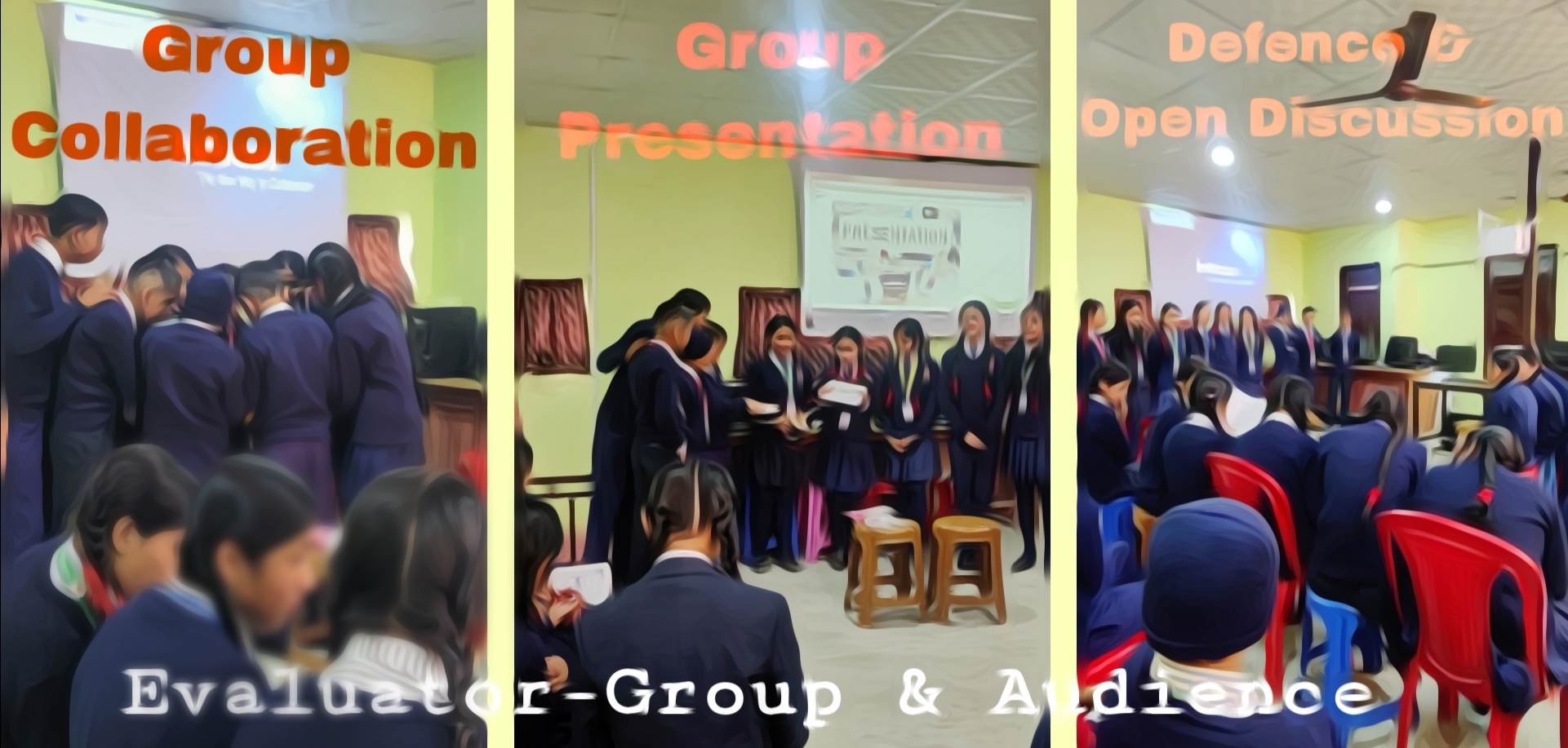
[Knowing this, I explained how my previous participant Mrs. Bharati used to offer peer evaluation by showing them Image 4.5.] Now and afterward, they promised to apply for it after discussing it with seniors as well. [Continuing to offer to the students in projects, I ask them whether they address students’ space during the project or not; space like Students’ choice and voice, freedom to inquire group selection or any, and what type of challenges are they facing while conducting the project?]
Mrs. Smita: “Miss Shrestha and I both, are supporting and addressing students’ choices and voices during the project. To encourage opening their choices we initially inquire and interact about checking in for the project where we try to find out their students’ existing knowledge and how their students can complete the project. We try to find out the preliminary ideas from our students and in the case of home-based projects, we just recommend not choosing costly and time-consuming methods. Otherwise, students are free to handle laboratory equipment, conduct hands-on activities for their respective projects, and foster creativity, they are free to design and model that can reflect the content. We proudly announce that our sixth-grade students can comfortably handle and use the glassware laboratory equipment according to their related activities. In the case of challenges, while doing the project; I said that though I am trying to look after all students, I still find that all students are not engaging uniformly in the activity and that a few students in certain groups are not giving proper attention in group work and the same students bring trouble to their friends during the presentation and preparing a report in the worksheet. For the experimental activity report, all students have to do the same experiment in different groups, but the report of the experimentation is the same, here, we are finding most of the reports are copied from the first doer. Sometimes due to over-excitement, the laboratory hall becomes too noisy, and we have to exert extra effort to control it. In the case of home-assigned projects, we were aware of few guardians not making them buy expensive and more than necessary quantity; students are wasting and using carelessly tools like paper charts, watercolors, clay, and other stationery items for the projects.”
Miss Shrestha: “Yes, we are supporting and addressing students’ choices and voices during the project. To encourage opening their choices we initially inquire and interact about checking in for the project where we try to find out their students’ existing knowledge and how their students can complete the project. We try to find out the preliminary ideas from our students and in the case of home-based projects, we just recommend not choosing costly and time-consuming methods. Otherwise, students are free to handle laboratory equipment, conduct hands-on activities for their respective projects, and foster creativity, they are free to design and model that can reflect the content. We proudly announce that our sixth-grade students can comfortably handle and use the glassware laboratory equipment according to their related activities. I am facing another challenge: some students are not even trying to write reports in science worksheets or give full effort during any activity.”
[Knowing this, I immediately asked them how they were mitigating such challenges. In such cases, both are taking support from the administration and counseling them along with their guardians to support them in completing the projects. Moreover, they are also trying to make active involvement and equal roles of every student by grouping including the leader, brilliant, average, and weak performers in every group.]
Perspectives Toward the Current Science Education
[And the last question I asked them concerning their perspective on science curriculum and wanted to know what change in it makes them more comfortable or how they assume their best curriculum.]
Mrs. Smita: “For me, the current science curriculum is the best so far because it incorporates more life-based and activity-based learning, but I feel to some extent that the theoretical part is heavy in the point of assignment and daily assessment aspects.”
Miss Shrestha: “Supporting Mrs. Smita, I want to add that the current science curriculum is highly prioritizing the scientific method of learning and authentic uses of ICT which are the best parts and teachers also need to update themselves accordingly. In addition, the new curriculum allows for learning professional skills and outcomes. For me, there is no assumption to be made for the better, instead, I want to be skilled and well-trained to fulfill the current curriculum.”
Reflection on the Observation
After a three-week hiatus due to a session break, I was invited to observe the regular teaching approaches. During the break, Mr. Sapkota facilitated regular communication to explore missing data. On the day of my visit, I had two objectives: to check in with members and to observe their project-based teaching approach. Unfortunately, due to my late arrival, I was only able to observe Mrs. Smita’s class, as Miss Karishma had already completed her observation of the cell activity for sixth graders.
Upon completion of informal discussions with all relevant members, I visited the classroom for observation. I found that the students were highly engaged with their teachers. The project was for fourth graders and involved active participation in inquiry and observation. Teachers brought in plants as teaching materials, intending to teach students about different types of roots, leaves, and seeds through hands-on inquiry and observation. Students worked in groups to generate knowledge by observing the plants, comparing them to pictures in their books, and engaging in interactive discussions. It was observed that students frequently asked and answered questions with their teachers like which plants are these while the teacher asked to compare the real parts of the plant with the picture in the book, to label them by showing the parts, and identifying the types of roots and leaves. Students collaborated with their peers to make meaning through comparison with pictures. Students were allowed to touch and observe the plants one by one while the teacher recorded their activities, participation in collaboration and interaction, and the accuracy of their responses. At the end of the lesson, the teacher engaged with each student individually, allowing them to reflect on their understanding and ask any questions they may have had about me. Instead of my introduction, one student inquired about the reason;
“Why reticulate venation leaves are only found in tap root plants, while parallel venation leaves are only found in adventitious root plants?”
I explained that this is due to the difference in seed types; dicot plants have two cotyledons in their seeds and produce tap roots and reticulate venation leaves, while monocot plants have one cotyledon in their seeds and produce adventitious roots and parallel venation leaves. Further, I encouraged the students to observe maize, paddy, mustard, and bean plants, which were currently in season, and to examine their seeds, roots, and leaves. Thus, the bell rang and they greeted and said farewell to me with happy faces.


Result and Discussion
Mrs. Smita and Miss Shrestha perceive the current science curriculum positively. Mrs. Smita appreciates its emphasis on life-based and activity-based learning, although she finds the theoretical part heavy. Miss Shrestha values its focus on the scientific method of learning, authentic uses of ICT, and its promotion of professional skills development. Observations of their teaching practices reveal a project-based approach involving active student participation in inquiry and observation (Herranen & Aksela, 2019). They utilize locally available teaching materials and encourage students to work in groups, compare observations with textbook images, and engage in interactive discussions to overcome learning obstacles (Jenkinson, et al., 2017). This approach fosters an inquiry-based learning environment where students feel comfortable asking content-related questions. From Mrs. Smita and Miss Shrestha, valuable practices of fostering PBL were insighted in basic level science education.
Experiential Teaching: Both teachers prioritize hands-on experiences, fostering positive attitudes, responsibility, community engagement, and student self-awareness, aligning with the principles of experiential teaching (Bouslog, 2020). They categorize projects into various types such as Lab-based (inside/outside), Daily-life based, and classroom-based, reflecting the diverse approaches of PBL including Place-based, Activity-based, and Challenge-based learning. Moreover, Miss Shrestha’s concept of focusing more on Inquiry-based also known as project-based (Worgan, 2023) where students actively discuss their tasks, free to implement their ideas or inquire their teachers.
Collaboration and Communication: They balance project work to strengthen content understanding, collaboration, and communication skills. They observe significant collaboration, group planning, leadership, and group work during projects, highlighting the importance of communication in PBL (Banwart, 2020; Shuffler et al., 2018). Both teachers respect and address students’ choices and voices, promoting student autonomy in the learning process however, Mrs. Smita has to emphasize more to instruction rather than fourth to sixth graders students’ self handling and decisioning in activity.
Addressing Challenges: The challenges encountered in Project-Based Learning (PBL) are recognized. For instance, Mrs. Smita grapples with ensuring uniform participation in activities and maintaining focus during group work. On the other hand, Miss Shrestha struggles with report writing, managing group conflicts, and facilitating their resolution. To address such challenges, they seek administrative support and counsel students and their guardians whenever necessary to assist them in completing projects (The Daily Texan, 2018). Despite these efforts, their evaluation approach remains teacher-centric, lacking the implementation of peer evaluation among members within and across groups.
In conclusion, the culture of implementing PBL as demonstrated by Mrs. Smita and Miss Shrestha emphasizes experiential teaching, diverse project categorization, collaboration, communication, student autonomy, and a proactive approach to addressing challenges.
Acknowledgement
I express my heartfelt gratitude to
the participating teachers and their dear students for their commendable
dedication and commitment to fostering an enriching learning environment. Their
passion for teaching and ability to bring out the best in their students is
truly inspiring. Their invaluable insights and experiences have been
instrumental in this endeavor.
REFERENCE
Barron, B., & Darling-Hammond, L. (2008). Teaching
for Meaningful Learning: A Review of Research on Inquiry-Based and Cooperative
Learning. Book Excerpt. https://api.semanticscholar.org/CorpusID:58734474
Blake,
D. (2018). How to Help Your Employees Learn from Each Other. Harvard
Business Review. https://hbr.org/2018/11/how-to-help-your-employees-learn-from-each-other
Jenkinson,
H., Leahy, P., Scanlon, M., Powell, F., & Byrne, O. (2019). The Value of
Groupwork Knowledge and Skills in Focus Group Research: A Focus Group Approach
With Marginalized Teens Regarding Access to Third-Level Education. International
Journal of Qualitative Methods. https://doi.org/10.1177/1609406919881853
Shuffler,
M. L., DiazGranados, D., Maynard, M. T., & Salas, E. (2018). Developing,
sustaining, and maximizing team effectiveness: An integrative, dynamic
perspective of team development interventions. Academy of Management
Annals, 12(2), 688-724. https://doi.org/10.5465/annals.2016.0045
The
Daily Texan. (2018). Group work hinders students more than it benefits them.
Retrieved from https://thedailytexan.com/2018/10/11/group-work-hinders-students-more-than-it-benefits-them/
Wingerden, J. V. (2018). The motivational potential of
meaningful work: Relationships with strengths use, work engagement, and
performance. PLOS ONE, 13(6), e0197599. https://doi.org/10.1371/journal.pone.0197599
Worgan,
M. (2023). Inquiry-based learning: make your classroom more inclusive.
Cambridge University Press.
Yeo,
J. & Nielsen, W. (2020). Multimodal science teaching and
learning, Learning: Research and Practice, 6:1, 1-4. https://doi.org/10.1080/23735082.2020.1752043
Cite this article:
Limbu, S. (2023). Exploring the Culture of Practicing
Project-based Learning by In-service Science Teachers: An Ethnographic Inquiry
[MPhil dissertation, Kathmandu University].